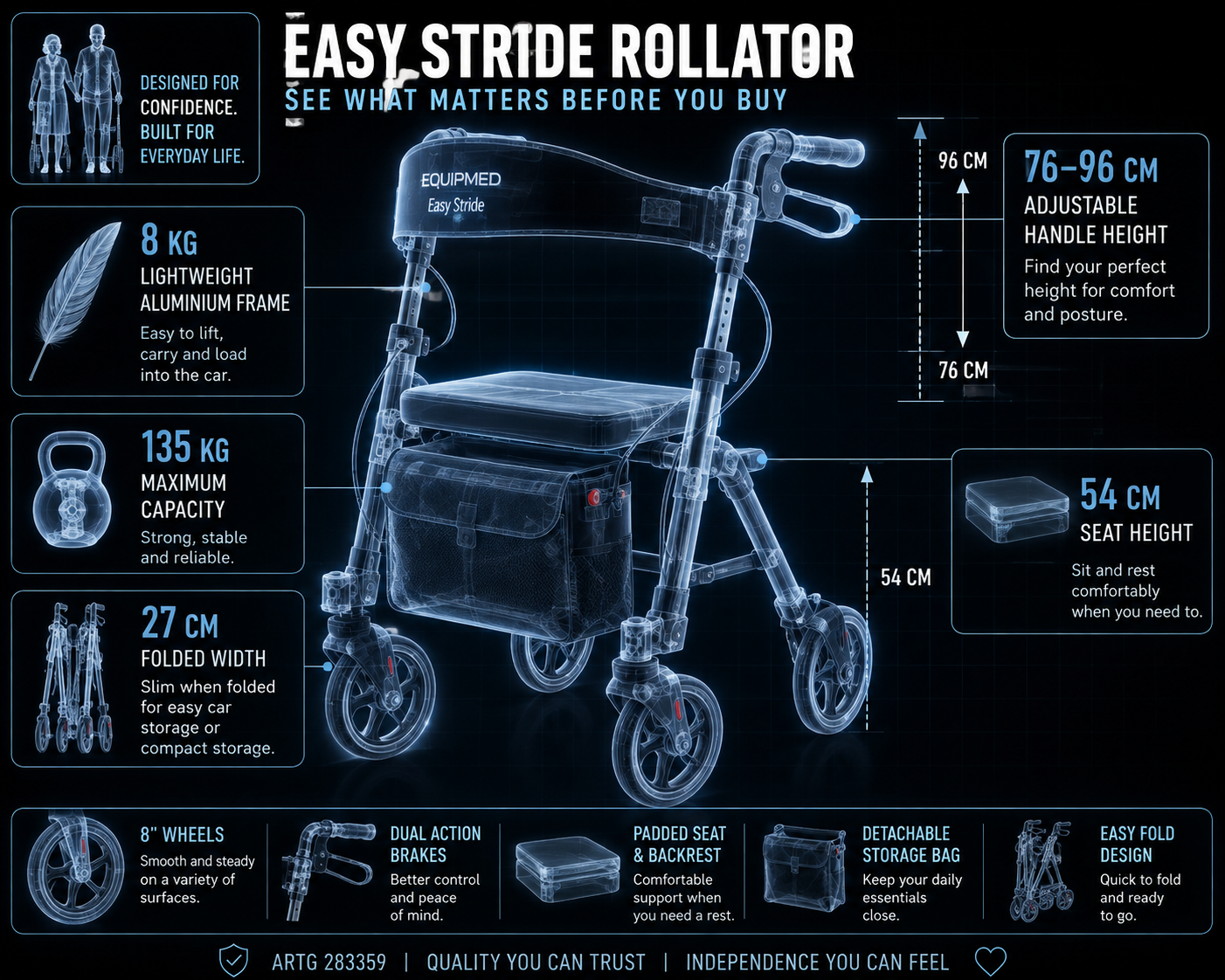
Choosing a rollator is not simply a matter of matching it to someone’s overall height. Handle height, seat height, total width, weight capacity and the spaces where it will be used can all affect whether it feels comfortable and manageable.
A suitable rollator should allow the user to stand upright, relax their shoulders and reach the brakes comfortably. Taking a few measurements before comparing models can help rule out products that are too tall, too wide, too heavy or difficult to store.
Start with these five checks
Before choosing a rollator, measure or check
- The user’s wrist crease height while standing naturally
- A chair height they can sit on and rise from comfortably
- The narrowest doorway or passage the rollator must pass through
- The available car boot or storage space
- The user’s current weight compared with the safe user weight limit
Always compare these figures with the specifications for the individual rollator. Overall height alone is not enough to determine whether a model will suit someone.
Before you begin
This guide provides general product information and is not medical or clinical advice. Mobility Tree cannot assess individual mobility needs.
Anyone with balance difficulties, reduced strength, a history of falls or concerns about walking safely should speak with a qualified physiotherapist or occupational therapist.
What you will need
Have a tape measure, the user’s usual walking shoes and a firm chair ready. It also helps to have access to the important doorways, hallways, car boot and storage area.
Another person can make the measuring process easier and help check that the user is standing naturally.
1. Measure the rollator handle height
Ask the user to stand upright on a level surface while wearing the shoes they normally walk in. Their arms should hang naturally beside their body and their shoulders should remain relaxed.
Measure vertically from the floor to the crease of the wrist. This gives you a practical starting point to compare with the rollator’s advertised handle height range.
When the user holds the handles, their elbows should remain slightly bent. They should also be able to reach and operate the brakes without stretching, raising their shoulders or gripping awkwardly.
NSW health guidance uses the same general starting point of standing upright with relaxed arms and positioning the handles around wrist crease level.
Signs the handles may need adjusting
The setting may not be suitable when the user
- Leans forward heavily
- Raises or tenses their shoulders
- Locks their elbows straight
- Struggles to reach the brakes
- Feels too far away from the frame
There is no benefit in forcing one exact setting if it feels uncomfortable or unsafe. The manufacturer’s instructions and individual professional advice should always take priority.
2. Check the rollator seat height
A rollator seat is generally intended for short rest breaks. The height of that seat can affect how comfortably someone sits down and stands again.
There is no single seat height that suits everybody. A useful starting point is to measure a firm chair the user already finds comfortable.
Ask them to sit on the chair and stand again in their usual way. Measure from the floor to the top of the seat near its front edge, then compare that figure with the advertised seat height of the rollator.
Where possible, trial the rollator before buying it or ask a health professional to help assess the fit.
Check sitting and standing carefully
During a supervised trial, look at whether the user can approach the seat, turn around and sit safely. Both brakes must be locked before they sit.
The seat should not leave them feeling perched too high or lowered so deeply that standing becomes difficult. Their feet should feel supported and they should be able to rise without pulling themselves up using the rollator handles.
A lower seat can require more leg strength. Balance, leg length and sit to stand ability can also affect what feels manageable.
Using the seat safely
Place the rollator on firm, level ground and lock both brakes before sitting. Positioning it against a stable object may provide added reassurance where practical.
Always follow the manufacturer’s instructions and safe user weight limit.
A standard rollator must not be pushed while someone is sitting on it. Only a product specifically designed as a rollator transport chair should be used to move a seated person.
3. Measure doorways and indoor spaces
The rollator needs to fit through the spaces where it will actually be used. Start with the narrowest doorway, hallway or gap between furniture.
Measure the clear opening from one inside edge to the other while the door is open as far as it normally opens. Compare that measurement with the rollator’s advertised overall width.
Do not confuse the seat width with the total width of the rollator. The wheels, handles, frame and brake cables may make the complete product considerably wider.
Leave enough clearance for the user’s hands and for small steering corrections. A rollator that only just fits on paper may still be awkward to control through the opening.
Think beyond the doorway
Consider whether the user can turn the rollator comfortably in the bedroom, bathroom, kitchen and hallway. Check lifts, entrance doors and areas where furniture reduces the available space.
One simple option is to mark the advertised rollator width on the floor with removable tape. This gives a clearer picture of how much space the frame and wheels may occupy.
Queensland Health guidance also considers doorways, corners, confined spaces and the person’s usual environment when assessing a walking aid.
4. Check the folded size and car boot space
A rollator can fit comfortably around the home and still be difficult to transport. Check both the open dimensions and the folded dimensions before choosing a model.
Measure the narrowest part of the car boot opening first. Then measure the usable width, height and depth inside the boot.
This distinction matters. A folded rollator may fit inside the available space but still be too large or awkward to pass through the opening.
Measure the cupboard, garage or other area where the rollator will normally be stored as well. Shelves, doors and nearby objects can reduce the usable space.
Consider the lifting weight
Check the rollator’s actual product weight in kilograms rather than relying on descriptions such as lightweight.
Find out whether the bag, backrest or other parts must be removed before folding. Also check whether the handles or seat affect how compactly it folds.
Most importantly, consider whether the person loading it into the vehicle can lift and control it safely. Anyone who cannot do this comfortably should seek assistance rather than risk an injury.
5. Check the safe user weight limit
Every rollator has a manufacturer specified safe user weight limit. Similar looking products may have very different capacities, so this figure needs to be checked for each model.
Record the user’s current weight and compare it with the safe user weight shown in the product specifications.
The storage bag may have its own separate carrying limit. Unused bag capacity does not increase the safe user weight of the rollator.
Always follow the manufacturer’s instructions for loading, storage and use. NSW guidance also recommends checking the safe user weight limit before using a four wheel walking frame.
6. Record the measurements
Customers can use the printable checklist while comparing products.
Download and print the Rollator Measurement Checklist →
Record
- Wrist crease height
- Comfortable chair seat height
- Narrowest doorway or passage
- Car boot opening width and height
- Available boot depth
- Storage space
- User weight
- Maximum rollator weight the person can safely lift
Keep these measurements nearby when reading product specifications.
7. Mistakes that are easy to make
One of the most common mistakes is choosing a rollator from the user’s overall height alone. This overlooks seat height, brake position, total width and the way the rollator will be used.
Other easy mistakes include measuring without the user’s normal shoes, confusing seat width with total width and measuring the inside of a car boot without checking the opening.
Descriptions such as lightweight can also be misleading when the actual weight has not been compared. A few kilograms can make a meaningful difference to someone who needs to lift the rollator regularly.
It is also important to check the brakes, safe user weight, bag capacity and intended surfaces. Not every rollator is designed for the same indoor and outdoor conditions.
Measurements can narrow the options, but they do not replace a safe trial or individual professional assessment where mobility concerns exist.
8. Make the final comparison
Before purchasing, check whether the rollator
- Includes the user’s wrist crease measurement within its handle height range
- Has a seat height the user can manage
- Fits through the narrowest doorway
- Has enough room to turn in the intended areas
- Fits through the car boot opening
- Fits inside the available storage space
- Can be folded and lifted safely
- Supports the user within its safe user weight limit
- Has brakes the user can reach and operate
- Suits the intended indoor or outdoor environment
- Includes clear manufacturer instructions
When professional advice is worthwhile
A physiotherapist or occupational therapist can provide individual advice when the user has a history of falls, significant balance difficulties or reduced grip strength.
Professional support is also worthwhile when someone struggles with hand brakes, sitting and standing, changes in walking ability or uncertainty about which type of walking aid is safest.
Rollator measuring questions
Can I choose a rollator using the person’s height alone?
No. Overall height may help narrow the options, but it does not account for wrist crease height, seat height, total width, product weight or the intended environment.
Where should the handles sit?
Wrist crease level while standing upright with relaxed arms is a common starting point. The final setting should allow relaxed shoulders, slightly bent elbows and comfortable access to the brakes.
Should the user’s feet touch the floor while sitting?
The user should feel stable and supported and should be able to stand again safely. Suitability depends on leg length, strength, balance and sit to stand ability.
How much doorway clearance is needed?
Avoid choosing a rollator that only just fits. Allow additional room for the wheels, frame, hands and safe steering through the opening.
Does lightweight mean easy to lift?
Not always. Check the actual product weight in kilograms and consider whether the person transporting it can lift and control it safely.
Can someone be pushed while sitting on a rollator?
Not on a standard rollator. Only use a model specifically designed as a rollator transport chair and follow its manufacturer’s instructions.
Sources and further reading
Content updated August 2026
Measure first, then compare
A rollator should suit the person, the home and the way it will be transported.
Taking these measurements before comparing models can help rule out options that are uncomfortable, difficult to control or too large for the intended space.
Measurements are a useful starting point, but they do not replace a safe product trial or individual advice where balance, strength, falls or mobility concerns exist.
Browse our rollator collection →
Return to the Mobility Tree Knowledge Hub →